I'd hardly call myself a trendsetter in speech-language pathology; - graduated from a reputable program at a state university, but not from a top-tier research-based training program with medical as well as educational affiliations -; having had many good jobs, in almost all the traditional worksites a speech - language pathologist might be found, though never hired by any big name clinical program; I have been honored to share knowledge with my peers at state and national meetings, and I have been given the huge opportunity to help in education and training of future professionals in the field. Are my writings or presentations cited anywhere?
I have worked alone, as well as part of a department of my peers. I've achieved nothing special so far, but I have always striven to sell the field to consumers, and represent speech-language pathology, to the best of my ability. With my work experiences running the gamut from residential programming for persons with severe/profound developmental disabilities, to residential/day programming for school - aged children with behavioral/emotional disorders, and from acute and outpatient rehabilitation for children/adults with neurogenic disorders, to adults residing in independent/assisted/memory care environments; - I have grown a persona, called elsewhere in this blog "the Doctor", who developed and helped manage treatment plans with a human face for the people I served, and who made the profession more than 'the best kept secret in town'.
Now, a little more about my professional identity. Long - time blog readers will realize that my goals for writing over the last 7 years, have included - WHAT THE HELL IS THIS SPEECH THERAPY ALL ABOUT? and HOW IS IT RELEVANT TO ME? I saw myself ideally, believe it or not, as the next "Cyclops" of the "X-Men". Stoic, strong, a disciplined leader; cleanly attired though conservatively, and incidentally, locked and loaded with the optic beam to right wrongs without any doubt. To that end, I developed the look that allowed Cyclops/The Doctor able to maneuver the environments he desired. The look, to my mind, gave me the appearance of a professional not intimidating, nor unreachable; nor irrelevant. All that was needed was for me to demonstrate how I could serve persons. This image fit in perfectly with my vision of what speech - language pathology was about: communication/cognition/swallowing occur everywhere; therefore, an SLP should look like a person you might see everywhere.
Still, inevitably - in many of the worksites I have frequented over the past ten years - I have been told that I couldn't wear anymore my business casual attire. I was instead required to wear a standardized uniform (often scrubs) in colors selected by administration; a uniform that marked me as part of a profession, or a guild. We were told, that physicians needed to take back the white coat. It was their mark of status, for over 100 years. SLP's were perturbed about that action, for those deep pockets in the white coats helped us carry all our stuff! We didn't want to take the mark of status away from physicians, but we wanted equal respect for our provision of evidence - based practice. The white coat, over our business casual clothing, conveyed to our consumers the sacredness of our commitment to their care. And now, it was gone.
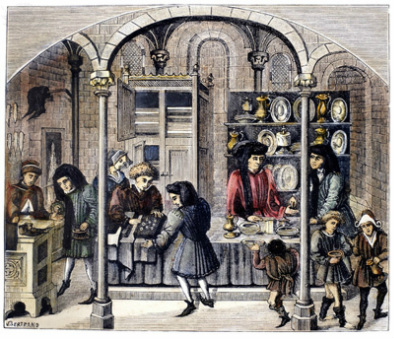
Guild? Seriously?! This is the memory most of us have of guilds: just a group of guys, standing up for lollipop quality. Identical spit curls, identical sneers, identical cut to the outfits, and - an identically begrudging workday dance. And that is largely the history of the guild movement over the centuries, from the zenith of the Middle Ages to today....so what keeps the quality of therapy in a guild? It's the de facto monopoly over targeted goods and services, that is given to SLP's as a historical gift from the guilds. Wonderful. We were able to make ourselves over as a distinct specialty, making mitosis from the teachers and the elocutionists, the oral myologists and the speech coaches - to untangle tongues and get children off to a good start.
So, perhaps I am being too harsh on the decision of management where I work, to take away my individual "look" and reinforce that I am a member of a distinct class. After all, my therapist "guild" - yes, we look the same as PT and OT now - has provided some benefits:
* the profession empowers and promotes the interests of women
* the collection of therapists offers mutual benefit and support
* the consumers identify your role more easily
* the uniform allows you protection for your personal clothing
* the uniform supplies many small pockets, to compensate for the loss of two big pockets
But - I had to admit to myself - I was still not comfortable with inhabiting royal blue scrubs at work:
* the individual disciplines continue to rely upon a caste system; PT and OT grew roots in the medical setting, gaining the accompanying prestige; speech-language pathology was birthed separately.
* the mutual benefit and support; who has time with the productivity goals that are set?
* the consumers hear you are from "therapy" and say, "I still can't walk that well".
* the uniform doesn't have the power that Jack Nicholson (the Joker) attributed to it, when he reputedly counseled Michael Keaton (Batman): "Let the suit act, kid".
*the numerous scrub pockets still limit the SLP's ability to carry materials, tools, etc., throughout the treatment day. Productivity demands require you manage every spare minute carefully.
* ABOVE ALL, the guild identity in a work setting is a 'governor', a 1000 pound boulder on the SLP's back, that puts on the brakes against individual initiative, individual insight and individual conscience. It opens the door to the clinician suffering moral injury*.
The Doctor still lives. You have to look for that professional in the SLP's eyes, and not at what s/he wears.
*Wendy Dean, MD, "The Real Epidemic: Not Burnout but Moral Injury of Doctors, Unable to do right by Patients", https://www.wbur.org/commonhealth/2020/01/24/moral-injury-american-medicine; posted 1/24/20 and accessed 1/27/20
"There was a call one day from the ER, that a teenager had been brought in for severe concussion that afternoon. We learned this - my TBI team and I - when we had reached the ICU to see the kid; - that he had been playing 'mailbox baseball'; you know - swinging a baseball bat from a speeding car, to knock the boxes off their supporting post. He had swung instead of ducked, and the mailbox took HIM out!
"Of course, we wanted to see him as soon as possible, to get baseline measurements of his function and, to start teaching any friends or family that might be near. Couldn't do that without a doctor's OK, though....the surgeon came from the ICU room, heard our pitch and then, floored us - absolutely LAID US OUT by his next statement: "He was drunk. He'll be OK". No referral. Dammit! We had been fine-tuning our diagnostic profiles for weeks, and now we're being told we can't help the kid - that recovering cognition is an afterthought?!?! What a short-sighted poltroon! Doctors have the power, though, dammit all. But they can't or won't do what we do....so, keep selling ourselves, was my lesson from that day. The surgeon thinks he can do speech therapy, but -
"Concussion, or mild traumatic brain injury (mTBI), can be extremely unpredictable when it comes to chronic effects. Not only are there the classic physical disruptions to consider; tinnitus, dizziness and headache - but the onset of cognitive challenges to attention, memory and higher cognitive functions; - and then there are often the emotional challenges a person with mTBI will face, when their world gets upended by changes that can occur. AM I CRAZY? - some persons will ask that, when they've told their PCP, a psychiatrist, a pastor, an employer or a teacher about their symptoms. You can use your bag of tricks to help them get back on the path to their life.
"Let the speech - language pathologist do speech therapy. We're cheaper than neuropsychology; we are well versed in turning diagnostic data into action; we aren't afraid to leave the sterile treatment room to achieve a real - life outcome; and we're good at teamwork, because we are the communication experts. We know how to achieve a connection. We can help prevent long-term disability, and help head off the development of neuroses. We can advocate for our patients, for their supports, and for the human service system. Just let us make the connection."
He said that to a young protege' nearby, 22 years old or so, as a new round of drinks were served to the table of conventioneers for the speech and hearing meeting. The night was young.
I first thought, when starting this post, that the subject was a "gift". Long-time readers of this blog will recall that I once blurted out - I didn't know what therapy was all about! Readers will also remember that the sign about therapy given unto me, as Linus gave one that Christmas to Charlie Brown, was built on the logic of the ICF (International Classification of Functioning, Disability and Health). That is, there are contexts for how a person served will function, across the domains of cognition, communication and swallowing. That is, though observer (therapist) A might see the person served at mealtime, showing behavior B (eating without coughing, choking), observer C (teacher, nurse, direct care staff) may report that the person, at mealtime, is doing behavior D (coughing up a lung). The therapist can also see the person served as an impairment of bodily function (loss of base of tongue retraction), vs impaired performance of an activity (chewing and swallowing a hot dog and bun), vs impaired participation in a social environment (eating dinner with friends in a restaurant).
As the designated expert in this clinical situation, you may have the answer sought to help a person served - often in a single observation, a cross-sectional observation that may capture sufficient data to pin down a diagnosis for therapy - or you may not. To get your job done as a diagnostician, answer these questions: are your tools sufficiently sensitive and specific to meet the clinical needs you have anticipated? Did you schedule the evaluation at the appropriate time? Did you access sufficient history beforehand, to plan an evaluation? If you enter the evaluation setting and you discover the person has entirely different needs than first reported, what are your backup plans?
Speech-language pathologists are able to study the culture of their work environment, to compose their personal ethnography of the worksite. This analysis of the physical setting, the persons served and the staff serving them gives you perspective for the needs of your person served, in the environment where their function is in question. Ethnographic study of an observation grows out of a longitudinal observation, borne out of multiple observation data collections; you note during the observations, trends in behaviors, the lines of formal power and actual power among staff and persons served, and the factors that may contribute to the presenting problem with the person served.
For example, the person served may be a grade school student who is nonspeaking; therefore, at the center of concern by numerous school staff, family and peers. Those numerous persons in the circles (or cloud) of support surrounding the student, affect her/his function passively and actively. How the cloud of support persons affects the student's behavior in question; that is, how they facilitate or impede her/his ability to communicate needs, share information, follow conversational competence rules, and maintain social closeness; this can influence the organization of your evaluation for this student.
Your detective work for the person served in her/his environment, where you are a passive observer gathering data, helps control for an observer effect that can affect the validity of your evaluation. The benefits of your ethnography of the worksite culture pop out, like snowdrop bulbs pop from snowbank before spring. What influences your person served in their natural settings, will be invaluable for you in evaluation and treatment planning.
I often tell the persons I serve, at the time of the initial evaluation, "your job is to get rid of me". Well designed and executed SLP treatment plans come about, partially as a result of a well - done evaluation. The evaluation, in turn, is most effective when the environments for a person served are best understood. Remarks overheard in a typical clinical environment: "Who is that guy, and what is he doing here?". He is lying in wait.
I occasionally tell my fellow healers with a half-smirk on my face, when trying to justify some bump in the road during a tough workday: "You know, speech therapy has an inferiority complex". It's an off - handed comment, very much like the very bad joke I use to decline a high-carb treat offered at work: "it makes my hair fall out". Some of my workdays are tough, though they're not any more frequent than those of any other speech-language pathologist. We're the communication specialists, aren't we? It's part of our mission to close the circle, to help
the joint establishment of meaning.
I share that comment about inferiority, because it sometimes feels as if everybody thinks they can do speech therapy. That's right! All the people with whom I work; all my family; neighbors; producers of TV shows and movies; the stakeholders of persons served, and their relatives and neighbors, etc. All these folks and more try to tell the story of CSD, without employing speech therapists to do the storytelling...I am Woody Allen on a "Dick Cavett Show" stage, kvetching about how unappreciated my colleagues and I can feel. Thirty-six years of work since receiving my "C's", have taught me that there is no shortage of others who know and can do an SLP's work, better than an SLP can.
My colleagues tell me that I shouldn't get my arytenoids in a bunch, about the free advice on clinical practice I'm given almost daily. Do I get this advice, because I slighted a person served? Does the advice betray some insecurity I have about my competence for the job? Should I just shut up and then say, "thank you" to my benefactors? I love my work, and know I do often make a difference. But, regardless of their motivation, it seems that there still occur in our practice settings, circumstances that bring about -
* no referral
* late referral
* vague referral
* colleagues making treatment decisions
* direct care staff making treatment decisions
We'll drill down - or, lift the shells - in a subsequent blog post.
May 5: It's time. It has to be time; time to get out into the garden and start supporting the growth of plants for our speech and language clinic. Not only will we grow spring plants that adorn windowsills and waiting areas of our clinic, but we will also mine a lot of clinical gold from the vegetables and flowers grown outdoors as a haven from the urban noise, and as a repository of good foods and visual delights.
Spring is the distant turn of sunlight, that gives us more and more motivation to brave still cold winds, scratch open the soil layers and insert a bit of germinal life into the desiccated, shivering world. It should be time. It has to be time, because we've waited so long. The FARMERS' ALMANAC says that the last spring frost date for this area is April 20, but there is so much to be done prior to that date. Please, let it be time.
There are, first, curriculum and therapy plans to be structured around garden activities. What are the plants; what are their characteristics; how will we plant, cultivate and harvest them; how will garden workers participate in the Spring - Fall growing season; what change will occur in the garden beds through the seasons; - and how will we communicate about and consume the fruits of the garden!?
June 1: Patience is a virtue. When the spring was approaching, I felt that it might take forever to get to this time of the year. There were the waves of thunderstorms; the alternating blasts of humid heat; the squirrels and other beasties, large and small; varying degrees of indecision by the clinical staff about what to plant, and how to train the persons served; - and, whew! How did we do it?
The curriculum fell into place easily, due to the fact that most plants have not evolved significantly since vegetable and flower gardens entered mass market visibility. You plant peas when the ground can be worked in spring, for example. When squirrels, rabbits and their kin are about, you plant enough for them, as well as for yourself. To remind those critters that they do not control this garden space, you plant enough for the critters and for you.
June 30: there's been a band of thunderstorm cells, passing by fast this afternoon. Thank goodness the 6 tomato vines, 4 pepper plants, pea vines, bok choi sprouts and romaine seedlings - all withstood the quick, hot storm. Too much accomplished, to lose plants to storm damage. It's time. Strength. Health. Vitality. It's time.
That's right. I said it. Practicing speech - language pathology requires an adventurous soul. As Merriam - Webster implies, speech - language pathologists are "disposed to seek adventure or to cope with the new and unknown".
You may have that day received numerous referrals for swallowing, many of them the aftermath of a single coughing episode for each person. Your treatment day may be marinated in boilerplate writing, to help keep the doors open. Meeting a milepost for your day, alongside that of a colleague, you may be asked "How many (patient appointments) do you have left?" Rapid rewrites of your daily schedule, require your turning on a dime to meet changing attentional demands by our customers. Get that documentation done before the end of business. Make the telephone calls. Attend the meetings, scheduled and impromptu. You have a productivity target to meet. Make sure you have all you need, to do the night work that lifts your work to the highest level of quality. Get it done. Do it!
You can hear in the background the pounding rhythm of "Working for a Living", by Huey Lewis and the News.The thumping; the pressure. There's always a need to strive, to push and to grasp the next rung on the ladder - surge ahead on the long staircase that is the rehab journey, to arrive at the next landing to gain perspective. What makes speech-language pathology work, adventurous? How does the CSD clinician prepare for the adventurous life? How does a professional plan for success, in such a workaday world?
I see an individual clinical encounter as dripping with adventure. Bold? Risky? Speech-language pathology? After all, you as the person's clinician guide persons served to tap energies they scarcely recognize within themselves. Changes in bodily function have apparently occurred out of the blue, and the person is often clueless how to remedy such a catastrophic event.
You are well prepared by training to take the arduous journey that evaluation and treatment represent. Your adventure begins with leading the person beyond her limits of perception, of motor power or of reasoning. Does she find the strength to recover from being lost in a dark wood, not able to affect change in her skills without your help?
With the evaluation done, there is the refocusing of the quest to achieve the person's goals. When the person served can contribute energy to identifying and clarifying the goals, the road to reaching them is clear. A clear path to the person's goals helps give agency to the person, and makes her the one wearing the armor.
An adventurous quest to achieve treatment goals may still bring many challenges; physical, psychological, financial, spiritual, and so forth. There are hills to climb, torrents to ford, monsters to confront and territory to claim. The person served learns to recognize decision points to be met during her treatment program. She gains confidence for acting as it is needed, and when it is needed.
The quest may, regardless, seem contrived, complex, cumbersome and "not real life". The person served may sometimes say, "I'm never going to use this". The adventure of a person's treatment program will stand the test of time when done right - when the goals sought after are firmly in hand, when the future is easily imagined, and quests are yielded to others more in need.











/arc-anglerfish-arc2-prod-mco.s3.amazonaws.com/public/STH6AQTLH5DKVDE4X2RRY3JI6Q.jpg)


