Sunday, August 23, 2020

My Church

I've not been here for some time, that's right. I know the reasons I haven't been here, and they're not that hard to discern if you have been an 'essential worker' on the 'front lines', working under 'an abundance of caution' and 'sheltering in place' when not serving your patients. An aside:

Geez! I know buzz words are useful sometimes to bind together members of a language community, but how far does the trend have to extend? What can cut through the murky meanings in buzzwords, to actually share what is these days, on our minds? There's enough to do in daily therapeutic alliances we engage as SLP's, without having to swim through linguistic muck that impedes. Where does true communication emerge? How can we achieve better therapy outcomes, without having to swim through word sludge?

SLP's, where is thy mojo?

 I decided to share a source of my positive energies for clinical work, and all associated foolishness, because I know this blog is one evidence of me. In the final analysis, 'who the hell am I?' (Ferris Bueller); yet, many of us want a legacy. So be it. The die is cast. I write here, not only to give my own perspectives on the fields of communication sciences and disorders, but to give evidence of how one life can be lived. 

I married a Lutheran woman and soon afterward, joined her church.  We found a small church body near home, listed in church registries as an "American Lutheran Church" congregation. Shortly after we established membership there, the church became part of the "Evangelical Lutheran Church in America", through merger with another group. The cultural lineage of the church, Northern European, was not that important to me, but the culture of the church did influence its message. 


That culture was embodied not in the color of the hymnal (red vs green), nor in the ethnic heritage of the charter members (German vs Norwegian vs Danish), but in the personality of the pastor. He's dead many years now. He and his mojo have been a huge influence on me, for many reasons. In the Lutheran traditions, scholarship by history, chemistry, psychology, linguistics, and other fields have tempered their/our use of the Bible. That scholarship has allowed teachers of church doctrine to spread their news, prepared to back it up with data. This pastor did that with exuberance, with intelligence, and with drive.

 Drive was both a blessing and a curse for this guy; he was a Type I diabetic, and the demands of his vocation eventually took him. But this is not a testimonial to a single personality; it is a testimonial to the spirit of the place - where two or three gather together in Her/His name. 
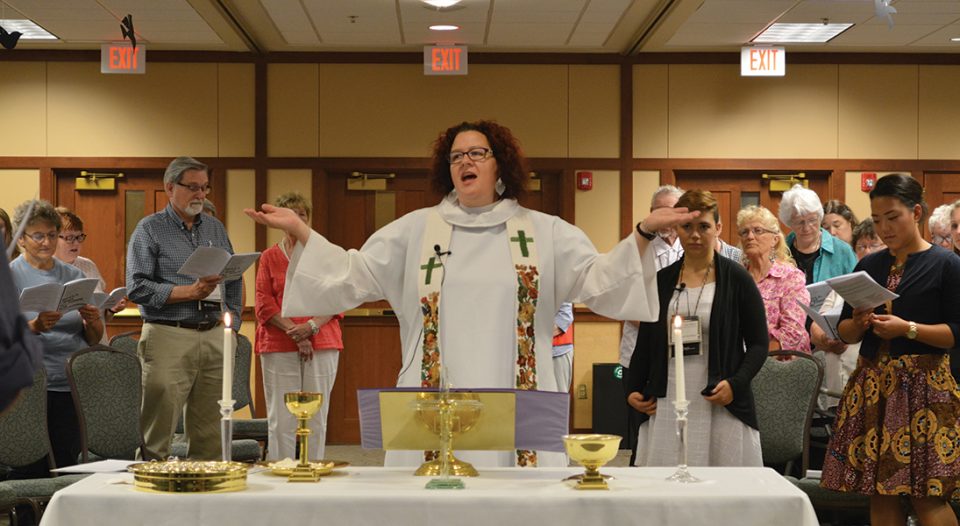


I spent my years there busy: teaching Sunday school for grade and high schoolers; assisting the Pastor in worship service; taking part in adult education; serving in stewardship, deacon, education and chairing the church council. Not only was it a bonding force for my family, but it also was a deep, rich internship in true communication - in connecting with the larger family. 
 

What is the ultimate benefit, of being part of a church family? How does it translate to how the SLP clinician does her/his daily work?  Like the clinical setting, where we may think in jargon but share what our persons served will understand - we share with members of the church body, and the wider world, in the language they use. We do it with drive, because there is so much need to be clear and meaningful. We do it with compassion, because our world wide diverse family becomes even healthier and intertwined with that emotional binding. And we do it with data, because in this world of alternate facts and social mudslinging, facts matter....so that when we make that connection and the persons we serve benefit, that connection to the greater good is locked in. 

That might mean for the SLP professional, that a well - structured and well - paced training session, may switch abruptly to a counseling session; - that, in addition to helping the person served build confidence in new habits, the family members and community supports also have their needs attended; also, that clinicians who enjoy their jobs, enjoy it for more than that designated outcomes are achieved. 

Minister, SLP's. "Flatten the curve" and get right to the issue. Communicate well, so we won't need a tissue.


My profession. My ministering. My church. It's clear.

Sunday, April 5, 2020

There is a danger

We're all talking about it, living it, fearing it and hunkering down because of it. It's been a great leveler of class and status over the past few weeks, and is now more a cloud of despair and suspense, enveloping the entire horizon. The Doc and the door attendant; barista and bank official; house hubby and Homeland Security boss....they all anticipate flattening the curve; they all want it, exclaim it, preach it, and attempt to work towards achieving it. We SLP's want that to happen, desperately, and want to do our part to make this nightmare evaporate like boiled grain alcohol. We want to do our jobs, as difficult as they can often be - we just want to serve somebody.

"Flatten that COVID,
Flatter than a cake;
Flatten that COVID -
Let our national fever BREAK!"


That's just pure silliness, though. Every waking hour of every day, we're all fully realizing now what a horrible predicament into which we've found ourselves...it's oozing under the cracks of our doors, under and around our closed windows, and then - it's coating everything! It's on our skin! It's in us?? With each day, it seems as if the scientists, the clinicians and the politicians are bantering about new facts about this disease, and we're suddenly shifting gears on precautions - what should we believe?!? How can we keep up? How do we stay alive?


That is all wild fantasy, of course. All that naked fear - with all that is in the news, and in the public service announcements, and on billboards and in social media up to our bandwidth's width - we know it is, COVID-19; it is just a conglomeration of nucleic acid particles, in the air and on surfaces, that loves to make new friends that tend to herd together. We are faced, worldwide, with the threat of this little bugger who just wants to cover the world with its mischief. It wants to infect us and make more of itself; it doesn't care who any of us are, but that we help perpetuate the species. Something so simple, and yet so powerful?!? Laying waste to world economies and civic life everywhere?? Why can't we stop this?


In the final analysis, we know we can stop this. The steps, the processes are hard but - we know they will work. In spite of all the political warfare and backstabbing; in spite of the dire shortages of material experienced among health care workers, first responders and other front-line warriors in the virus war; in spite of the lack of thorough information on how many persons are infected - we know that the recommendations to slow transmission do and will work, until we get a vaccine. We've crossed the bar, realizing that life has fundamentally changed because of our need to stay safe. Now that that's done - the SLP picks up her equipment bag and goes back to work.

"Flatten that COVID,
Flatter than a cake;
Flatten that COVID -
Let our national fever BREAK!"


Tuesday, February 11, 2020

The campaign rally

The Pacific sun was bright that afternoon. Most of the conventioneers present had come to town a day early, mostly because - hell! - it was southern California in November and we'd all rather be here. But what were they seeing, as they approached the beach, just south of the SD Convention Center and opposite Harbor Drive from PETCO Park....? It was a campaign rally, so a first wave of curious tourists were initially repelled at the sight. "Green Goddess Gertrude, we've just recovered from all of that campaign stuff that had been going on - SINCE FOREVER!" But as the crowd attempted to turn and avoid the noise and the colorful signage, they realized it was an SLP campaign rally...but for what?!


Big and colorful pennants, each about 12 feet in height, had been driven into the sand symmetrically about a central stage. Each banner gave a first hint at the purpose for our pilgrimage to the beach that afternoon. Still, the sun was so bright that I had to squint though my Transitions lenses, to read them all:

*PREVENTION!*
*Primary*
*Risk Management*
*Secondary*
*Surveillance*
*Tertiary*
*(Re)habilitation
*Diet*
*Fitness*
*Mental Health*
*Public Health*
*Community Building*
*Civic Engagement*


There were the banners, and there was music....I'm guessing it was a collage of the hip - hop artists of the moment, and we were all tempted to grab a drink and just party on the beach. No such luck, I found out - ! The music was building, and as a verse of the last song grew louder and LOUDER....then a whole phalanx of enthusiastic young people rang the stage to applaud on a relaxed, but authoritative looking speaker. The speeches began with this person's stem-winder: -

HELLO! THANKS FOR COMING OUT TO OUR PREVENTION RALLY. ASHA WAS NOT QUITE SURE THAT THIS EVENT NEEDED TO HAPPEN, BUT - WE'RE HERE AND WE'VE COMMANDEERED THIS BEACH UNTIL ASHA SAYS WE'RE DONE!


WHAT DO WE WANT? PREVENTION!
WHEN DO WE WANT IT? NOW!!

NOW - THE NEXT QUESTION IS - WHY DO WE WANT IT?

WE WANT PREVENTION IN OUR PRACTICES, BECAUSE WE CAN REACH MORE PEOPLE. WE CAN REACH MORE PEOPLE  BY EDUCATING THEM ABOUT THE OPTIONS FOR THEIR HEALTH THAT ARE AVAILABLE. THE OPTIONS ARE RISK REDUCTION AND RISK REMOVAL; SURVEILLANCE; THERAPY. WE KNOW ABOUT THERAPY. SOME OF US HAVE DONE THOUSANDS OF HOURS OF THERAPY DURING OUR CAREERS. SOME OF US, MANY AMONG THE SAME GROUP WHO ARE THERAPY VETERANS, HAVE DONE MANY, MANY SURVEILLANCE OR SCREENING CLINICS. MANY OF US, THOUGH, HAVE NOT INCLUDED ACTIVITIES OR PRODUCTS IN OUR CLINICAL WORK, THAT ACHIEVES RISK MANAGEMENT.

Some of the crowd had been wavering on staying for the speech, before the beach side bar had opened. All virgin drinks, but everyone knew the event was stressing, there're healthy options for refreshment available. The other stuff will always be there, but adults get to choose - and make better choices - when they understand their options:

NOW, RISK MANAGEMENT - OR PRIMARY PREVENTION, WHATEVER YOU WANT TO CALL IT - IS IT SOMETHING MOST SLP'S DO? NO. IS IT A SKILL SET MOST OF US HAVE? NO. WILL IT BE EASY FOR ALL TO TAKE ON A NEW SKILL SET? NO.  WILL SOME SLP'S WANT THE SKILL SET? YES. WILL SLP'S IN ALL WORKPLACES WANT TO DO THIS? DO CHILDREN BENEFIT? YES! DO ADULTS BENEFIT? YES! DO OUR PRACTICES BENEFIT? YES!! DOES THE FIELD BENEFIT?? A RESOUNDING YES! WHAT DO WE WANT? WE WANT TO LOWER THE RISK. WON'T THAT PUT US OUT OF WORK? NO. WON'T THAT BE A SECOND JOB? NO. WILL IT CHANGE THE FIELD? YES. WILL THE PUBLIC KNOW US BETTER? YES! WILL THE PUBLIC BE HEALTHIER? YES!! DO WE WANT THAT? DO WE WANT TO DO RISK MANAGEMENT?


And the crowd yelled back, YES!!!


Monday, January 27, 2020

Lonely Are the Brave Clinicians

"I have so many treatment plans to tweak tonight,


But the impeachment trial - OH MAN! That makes me mad - "


Apraxia

Aspiration precautions

Passy - Muir fitting

Phonological processes

Semantic features

Tracheoesophageal fistula

"It's a good thing I know what all this stuff is -

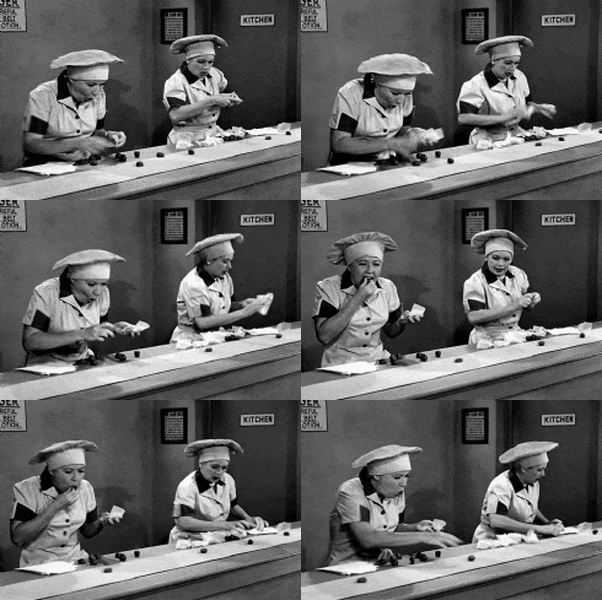
The day was a fast - forward conveyor belt of session after session;

I was Lucy Ricardo, and the chocolates were flying by!

I know what all this stuff is, and I know what to do....finally. "


Finally, the dinner for one is ready, eaten, washed - back to work.

"Is this the right goal? The best criterion?

When should I think about carryover?

I'm not sure s/he feels comfortable with what I am doing.

Did I make the right choice? All this PAPERWORK!

It isn't going to do itself, though...."


And then, very late at night, when all the other voices have quieted;

The rest of the words flow. 

"The patient completed the X Test of X. Total raw score of X converted to %ile of X, with severity rating of X."

"Patient demonstrated in elicited conversation, sentence formulation skills seen in most persons her/his age".

It's midnight now. Only X more records to go. 


Goodbye, Dr. Carey

I'd hardly call myself a trendsetter in speech-language pathology; - graduated from a reputable program at a state university, but not from a top-tier research-based training program with medical as well as educational affiliations -; having had many good jobs, in almost all the traditional worksites a speech - language pathologist might be found, though never hired by any big name clinical program; I have been honored to share knowledge with my peers at state and national meetings, and I have been given the huge opportunity to help in education and training of future professionals in the field. Are my writings or presentations cited anywhere?


I have worked alone, as well as part of a department of my peers. I've achieved nothing special so far, but I have always striven to sell the field to consumers, and represent speech-language pathology, to the best of my ability. With my work experiences running the gamut from residential programming for persons with severe/profound developmental disabilities, to residential/day programming for school - aged children with behavioral/emotional disorders, and from acute and outpatient rehabilitation for children/adults with neurogenic disorders, to adults residing in independent/assisted/memory care environments; - I have grown a persona, called elsewhere in this blog "the Doctor", who developed and helped manage treatment plans with a human face for the people I served, and who made the profession more than 'the best kept secret in town'.

 Now, a little more about my professional identity. Long - time blog readers will realize that my goals for writing over the last 7 years, have included - WHAT THE HELL IS THIS SPEECH THERAPY ALL ABOUT? and HOW IS IT RELEVANT TO ME? I saw myself ideally, believe it or not, as the next "Cyclops" of the "X-Men". Stoic, strong, a disciplined leader; cleanly attired though conservatively, and incidentally, locked and loaded with the optic beam to right wrongs without any doubt. To that end, I developed the look that allowed Cyclops/The Doctor able to maneuver the environments he desired. The look, to my mind, gave me the appearance of a professional not intimidating, nor unreachable; nor irrelevant. All that was needed was for me to demonstrate how I could serve persons. This image fit in perfectly with my vision of what speech - language pathology was about: communication/cognition/swallowing occur everywhere; therefore, an SLP should look like a person you might see everywhere.


Still, inevitably - in many of the worksites I have frequented over the past ten years - I have been told that I couldn't wear anymore my business casual attire. I was instead required to wear a standardized uniform (often scrubs) in colors selected by administration; a uniform that marked me as part of a profession, or a guild. We were told, that physicians needed to take back the white coat. It was their mark of status, for over 100 years. SLP's were perturbed about that action, for those deep pockets in the white coats helped us carry all our stuff! We didn't want to take the mark of status away from physicians, but we wanted equal respect for our provision of evidence - based practice. The white coat, over our business casual clothing, conveyed to our consumers the sacredness of our commitment to their care. And now, it was gone.


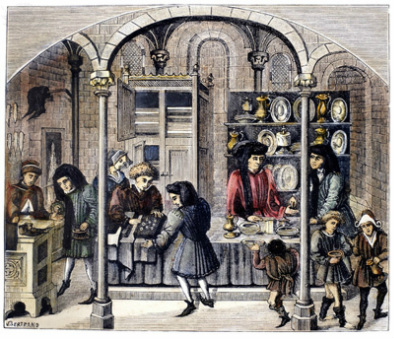
Guild? Seriously?! This is the memory most of us have of guilds: just a group of guys, standing up for lollipop quality. Identical spit curls, identical sneers, identical cut to the outfits,  and - an identically begrudging workday dance.   And that is largely the history of the guild movement over the centuries, from the zenith of the Middle Ages to today....so what keeps the quality of therapy in a guild? It's the de facto monopoly over targeted goods and services, that is given to SLP's as a historical gift from the guilds. Wonderful.  We were able to make ourselves over as a distinct specialty, making mitosis from the teachers and the elocutionists, the oral myologists and the speech coaches - to untangle tongues and get children off to a good start.


So, perhaps I am being too harsh on the decision of management where I work, to take away my individual "look" and reinforce that I am a member of a distinct class. After all, my therapist "guild" - yes, we look the same as PT and OT now - has provided some benefits:

* the profession empowers and promotes the interests of women
* the collection of therapists offers mutual benefit and support
* the consumers identify your role more easily
* the uniform allows you protection for your personal clothing
* the uniform supplies many small pockets, to compensate for the loss of two big pockets

But - I had to admit to myself - I was still not comfortable with inhabiting royal blue scrubs at work:

* the individual disciplines continue to rely upon a caste system; PT and OT grew roots in the medical setting, gaining the accompanying prestige; speech-language pathology was birthed separately.
* the mutual benefit and support; who has time with the productivity goals that are set?
* the consumers hear you are from "therapy" and say, "I still can't walk that well".
* the uniform doesn't have the power that Jack Nicholson (the Joker) attributed to it, when he reputedly counseled Michael Keaton (Batman): "Let the suit act, kid".
*the numerous scrub pockets still limit the SLP's ability to carry materials, tools, etc., throughout the treatment day. Productivity demands require you manage every spare minute carefully.
* ABOVE ALL, the guild identity in a work setting is a 'governor', a 1000 pound boulder on the SLP's back, that puts on the brakes against individual initiative, individual insight and individual conscience. It opens the door to the clinician suffering moral injury*.

The Doctor still lives. You have to look for that professional in the SLP's eyes, and not at what s/he wears.

*Wendy Dean, MD, "The Real Epidemic: Not Burnout but Moral Injury of Doctors, Unable to do right by Patients", https://www.wbur.org/commonhealth/2020/01/24/moral-injury-american-medicine; posted 1/24/20 and accessed 1/27/20

Saturday, January 11, 2020

From the front lines: the evidence from concussion care

"There was a call one day from the ER, that a teenager had been brought in for severe concussion that afternoon. We learned this - my TBI team and I - when we had reached the ICU to see the kid; - that he had been playing 'mailbox baseball'; you know - swinging a baseball bat from a speeding car, to knock  the boxes off their supporting post. He had swung instead of ducked, and the mailbox took HIM out!


"Of course, we wanted to see him as soon as possible, to get baseline measurements of his function and, to start teaching any friends or family that might be near. Couldn't do that without a doctor's OK, though....the surgeon came from the ICU room, heard our pitch and then, floored us - absolutely LAID US OUT by his next statement: "He was drunk. He'll be OK". No referral. Dammit! We had been fine-tuning our diagnostic profiles for weeks, and now we're being told we can't help the kid - that recovering cognition is an afterthought?!?! What a short-sighted poltroon! Doctors have the power, though, dammit all. But they can't or won't do what we do....so, keep selling ourselves, was my lesson from that day. The surgeon thinks he can do speech therapy, but -


"Concussion, or mild traumatic brain injury (mTBI), can be extremely unpredictable when it comes to chronic effects. Not only are there the classic physical disruptions to consider; tinnitus, dizziness and headache - but the onset of cognitive challenges to attention, memory and higher cognitive functions; - and then there are often the emotional challenges a person with mTBI will face, when their world gets upended by changes that can occur. AM I CRAZY? - some persons will ask that, when they've told their PCP, a psychiatrist, a pastor, an employer or a teacher about their symptoms. You can use your bag of tricks to help them get back on the path to their life.


"Let the speech - language pathologist do speech therapy. We're cheaper than neuropsychology; we are well versed in turning diagnostic data into action; we aren't afraid to leave the sterile treatment room to achieve a real - life outcome; and we're good at teamwork, because we are the communication experts. We know how to achieve a connection. We can help prevent long-term disability, and help head off the development of neuroses. We can advocate for our patients, for their supports, and for the human service system. Just let us make the connection."


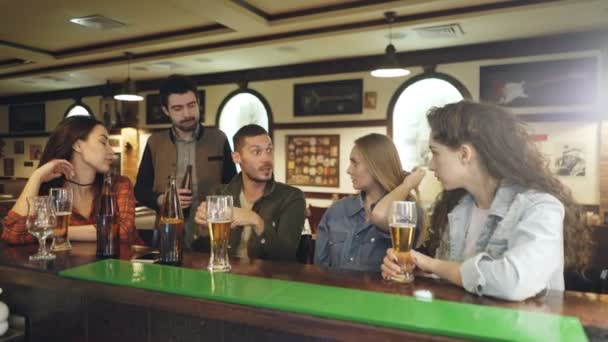
He said that to a  young protege' nearby, 22 years old or so, as a new round of drinks were served to the table of conventioneers for the speech and hearing meeting. The night was young.


Sunday, December 29, 2019

Lying in Wait

I first thought, when starting this post, that the subject was a "gift". Long-time readers of this blog will recall that I once blurted out - I didn't know what therapy was all about! Readers will also remember that the sign about therapy given unto me, as Linus gave one that Christmas to Charlie Brown, was built on the logic of the ICF (International Classification of Functioning, Disability and Health). That is, there are contexts for how a person served will function, across the domains of cognition, communication and swallowing. That is, though observer (therapist) A might see the person served at mealtime, showing behavior B (eating without coughing, choking), observer C (teacher, nurse, direct care staff) may report that the person, at mealtime, is doing behavior D (coughing up a lung). The therapist can also see the person served as an impairment of bodily function (loss of base of tongue retraction), vs impaired performance of an activity (chewing and swallowing a hot dog and bun), vs impaired participation in a social environment (eating dinner with friends in a restaurant).


As the designated expert in this clinical situation, you may have the answer sought to help a person served - often in a single observation, a cross-sectional observation that may capture sufficient data to pin down a diagnosis for therapy - or you may not. To get your job done as a diagnostician, answer these questions: are your tools sufficiently sensitive and specific to meet the clinical needs you have anticipated? Did you schedule the evaluation at the appropriate time? Did you access sufficient history beforehand, to plan an evaluation? If you enter the evaluation setting and you discover the person has entirely different needs than first reported, what are your backup plans?

Speech-language pathologists are able to study the culture of their work environment, to compose their personal ethnography of the worksite. This analysis of the physical setting, the persons served and the staff serving them gives you perspective for the needs of your person served, in the environment where their function is in question. Ethnographic study of an observation grows out of a longitudinal observation, borne out of multiple observation data collections; you note during the observations, trends in behaviors, the lines of formal power and actual power among staff and persons served, and the factors that may contribute to the presenting problem with the person served.

For example, the person served may be a grade school student who is nonspeaking; therefore, at the center of concern by numerous school staff, family and peers. Those numerous persons in the circles (or cloud) of support surrounding the student, affect her/his function passively and actively. How the cloud of support persons affects the student's behavior in question; that is, how they facilitate or impede her/his ability to communicate needs, share information, follow conversational competence rules, and maintain social closeness; this can influence the organization of your evaluation for this student.

Your detective work for the person served in her/his environment, where you are a passive observer gathering data, helps control for an observer effect that can affect the validity of your evaluation. The benefits of your ethnography of the worksite culture pop out, like snowdrop bulbs pop from snowbank before spring. What influences your person served in their natural settings, will be invaluable for you in evaluation and treatment planning.

I often tell the persons I serve, at the time of the initial evaluation, "your job is to get rid of me". Well designed and executed SLP treatment plans come about, partially as a result of a well - done evaluation. The evaluation, in turn, is most effective when the environments for a person served are best understood. Remarks overheard in a typical clinical environment: "Who is that guy, and what is he doing here?". He is lying in wait.