I was lucky enough to trust my impulsive nature, on the day I wanted to know more about the closing of a local grocery store. Local news media had made a lot about an ALDI store, thirty years active in Westside Chicago and far from Loop prosperity, suddenly going belly up. There was consternation expressed by residents. There was outrage heard from activist groups. And most recently, the city of Chicago has proposed buying the vacated store.
Since the neighborhood's median household income is roughly at the poverty level for a US family of three, and that just one grocery store remains to serve 17,000 residents, this seemed a serious concern. I am a speech- language pathologist who advocates for my consumers ' healthy eating; if there were a problem with consumers getting diets beneficial to their health, I would want to know what healthy solutions are out there.
Following is a podcast from the series "Curious City", produced at WBEZ radio in Chicago - wbez.org . It illustrates the issues. Thanks to reporters Linda Lutton and Asia Singleton.
Readers of this blog, who want to know more and be stimulated about food desert issues, should look at the 2022 book RETAIL INEQUALITY (University of California Press). The author, Kenneth Kolb, is Chair of Sociology at Furman University.
He hesitated before - stepping to the microphone, his sole anchor to the convention meeting room crowd. About 20, he estimated, scattered about the chairs numbering 100....the thoughts fly, as seconds ticked by to bring the start of my presentation: is the premise just TOO CRAZY? Will they see the holes that I SEE, in the logic of the presentation? Where can I HIDE, until they just GO AWAY in confusion? Darn it, here comes the session coordinator - hearing my provenance for the presentation as a background noise, I am ready. Gotta sell this! To the mic now, and -
"HIIIII - glad you could be here, and draw on that good night's rest you got last night, for the LAST DAY 8 o'clock session! You lucky people! Here we go. You're here, I hope, to learn about what the heck a WELLNESS CONCIERGE is, and why - audiologists and speech-language pathologists should be ready to assume this role, as a next step in their careers."
"Disclosures: my practice does include - possibly the only wellness concierge web - based subscription platform, amidst the CSD community. I also belong to my local Chamber of Commerce, which allows me to network with numerous peers in my business market area".
"Here we go. A CONCIERGE can be broadly described as a person you meet, at the entrance to a building. That person has the skill and resources to guide you through what the building, or in this case, the wellness industry has to offer. But the questions should abound: Why wellness? Why should CSD professionals take this on? Why is this added focus to our work lives so important now?"
"Ten of the top 10 causes of death in the US (NCHS, 2019), also bring significant disability into functional domains where CSD professions work. Though there has been significant reduction of mortality rates for heart disease, for example, the rate of reduction for deaths has slowed in recent years. Heart disease and its co-occurring morbidities are also striking in greater numbers, persons of younger age; - perhaps prompted by an increased rate of obesity in young people. There is then, a moral imperative as well as a scientific clarity, for bringing wellness to the larger sphere of healthcare. Namely, us. We are part of the larger sphere, we CSD professionals".
"So I am saying that audiologists and speech - language pathologists grow their clinical practices for all ages, in a fashion that reflects the true intent of the 1988 statement of ASHA's Prevention Committee - namely, to push ahead and help our communities lessen or eliminate risk factors leasing to disability. This presentation focuses on how the wellness concierge framework, might benefit primary prevention of cardiovascular disease (CVD)."
"Aphasia. Vascular dementia. Cochlear hearing loss. Labyrinthitis. Auditory processing disorder. The list goes on: insults to bodily function that arise from cardiovascular system breakdowns. When Aud's and SLP's are part of the solution to reducing CVD insilts, we help accomplish many objectives:
" * We naturally raise the visibility of our professions, audiology AND speech-language pathology, when we are active in the broader community, interacting in collaboration with other human service workers for health (fitness trainers, dieticians, smoking cessation specialists, gardeners, etc.)"
" * We grow our knowledge base for helping our consumers, when we reach from tertiary prevention (reducing the odds for disability), and secondary prevention (identifying potential impairments for bodily function) to primary prevention (reducing or eliminating exposure to risk factors for CVD)".
" * When we help the larger community access wellness information, services, and ways to sustain their desired level of function, we develop potential consumers who may be educated on accessing services, when/if the need might arise. "
"That's the rationale for becoming a wellness concierge, in capsule form. Now, how many forms will wellness concierge work take? They could include -
" * Communication Fitness - see the post for the 'Pretty Wonderful, Communication' blog, dated April 23, 2017"
" * Hosting events such as lectures, demonstrations, or gatherings to commemorate days, months or holidays relevant to a prevention topic (for example, October 1 is 'World Vegetarian Day')"
" * Directing curious consumers to community events that highlight a prevention topic, such as charity or fitness run/walks; chef - directed food and wine events vs. culinary school restaurant offerings; and presentations by medical vs. complementary and alternative medicine professionals; - "
" There's what we will do - now, after a short break, we'll reassemble and discuss HOW we will do each one - "
In the final analysis, what is the value to CSD professionals of primary prevention activities? How can clinicians accommodate primary prevention fully into their clinical practices? What are the payoffs for making primary prevention a viable product line, within your speech-language pathology or audiology practice? How will your market share be affected by your new product lines? How will the professions evolve as a result?
For myself, I needed to answer some questions about how any new product line (in this case, primary prevention) can be successful, to determine if primary prevention can be a successful adjunct to evaluation and treatment. I needed to know:
* what exactly is this prevention product?
Education activities designed to help consumers lower, or avoid risks for communication and swallowing disorders
* can I easily explain this to other people?
We can help keep you well for expressing yourself, and to eat and drink.
* how can I make the abstract idea, a concrete entity?
Identify, assemble and present activities, selected to help consumers at risk maintain wellness.
* is anyone else doing this?
(Readers? You can help answer this. Thanks.)
* if so, what are the forces that make their products marketable?
High interest 1:1, small group and large group educational events, targeted to consumers' identified needs.
* what is my market area, my niche?
(Fill in the blank, readers)
* does my market area want this?
Observe the activity near you at fitness centers, weight loss nutrition programs, smoking cessation programs, farmers' markets, etc.
* how do I find out if my market area wants this?
Ask your consumers and friends on your digital social networks, if they are curious about how to stay well and avoid cardiovascular disease, cancer, diabetes, etc.
* how do I market this?
Use all communication channels that touch your desired market, and make it easy for consumers to reach you and HIRE you.
* what distinguishes me from other practitioners in this area?
CSD professionals can link their educational activities to clinical interventions, as consumers request services
* do I have the credentials for this work?
Speech - language pathologists and audiologists can pursue independent study and coursework in health promotion
* what will be successful outcomes of primary prevention work?
Consumers demonstrate increased knowledge in risk reduction strategies for communication and swallowing disorders
* HOW WILL I GET PAID?
Readers? Those activities not funded by grants and other external supports , might require a fee for service, to justify the time and costs incurred to teach consumers, who may never buy your clinical services.
Those of you who have a primary prevention product - how do you do it?
Trapping evil spirits....I like ice cream. I really do like ice cream. One story from our family lore that I frequently tell new consumers, is that I learned the actual value of a batch of ice cream - when I had to make it. Now that I regularly make batches of communication starter, the story seems as fresh as that hot summer day.
In the early 1960's, the ice cream technology available at my house was the wooden bucket fitted w/ hand crank. My Mom made it a very simple transaction for me: you help make it, you get to help eat it! The result of what seemed like three hours (I swear!) of hard relentless churning of that peach bit + creme anglais, was that we had fluffy - and slightly saline - peach ice cream for our hot summer party. I had churned away the evil spirits of lassitude, powered by the desire for a cool summer treat. My left arm also grew back, within two weeks.
Now, the joy of a thick, frozen bite of ice cream is dulled by political backlash directed at an ice cream company. This company leads its business model with its own social values; it has chosen to restrict its product to a country, whose policy is antithetical to these values. Refer to:
I like Israel. I really like Israel. One ice cream company is not bringing down the state of Israel. State governments in the US, who see themselves as the guardian of Israel's legitimacy within the country, have swung the battle - axe of politics down on this company. It's ludicrous, and almost pathetic that Israel supporters fear an ice cream company. Rather than freeze up Israel's management of its internal affairs, the company shared its moral vision to illuminate the moral shortcomings of the nation.
The political strike against the ice cream company embodies an act of zealotry. As the late Arkansas journalist Paul Greenberg put it, a zealot either agrees with you too strongly, or disagrees with you strongly.
Some writers, like Reza Aslan, say Jesus was a zealot. Other writers like Eric Hoffer might point to the example of an Obama voter, becoming a Trump voter in the next cycle, as the zealot's mark. Not strictly is the intensity of a person's devotion considered, but also how the focus on the devotion blinds the zealot to the full measure of that devotion. What could possibly be wrong with trying to punish Ben and Jerry's parent company, for B&J supporting a people they see as oppressed?
I really like people, like Bronowski, who have strong opinions. Whether they force me to work to eat, defend my favorite dessert, or justify a clinical judgement - I do enjoy the arguments. These days, I see a lot of zealotry, in the forms of inflexibility, in the field of CSD. It could be coming from the training a clinician receives in pre-service education, or through subsequent continuing education. It also can bleed through from some social - political movements that occupy your mind, but that are tangential to this CSD gig you've secured. It could even be as simple as letting the pressures of real life get in the way, by getting entrenched in clinical 'ruts', doing the same activities with persons carrying similar diagnoses. A clinician who participates in research studies, may surmise that the protocol is always the thing. Everything.
However you delineate the actions of persons on the train of a clinical/research movement; - when every case becomes a strict research protocol, without back - channel communication that can be crucial to the consumer moving towards her desired outcomes, it's zealotry. We are selling a service, albeit a professional service, and it seems sensible to deliver the service the consumer bought.
Zealotry = evil spirits? Only in the sense that your perceptions, your judgement can be clouded by adherence to a narrow frame of reference (dogma, allegiance to mentor/leader), that has political as well as scientific implications to your effective practice.
I really like the bottle tree. It reminds me of how important it is, to trap and stow away things that don't belong - things that can prevent you from safe passage on your clinical journey.
I recently started, after a break of almost twenty years, the mentoring of two new SLP professionals. Recently, I committed to consider a third - yikes! Mind you, I've mentored a few dozen new SLP's at all levels of their career development, since taking this career path: shadows of a clinician during the undergraduate years; interns in a medical setting, prior to their receiving the master's degree; and lecturing to graduate students about aspects of the 'hidden curriculum' - that is, what actually happens during the SLP's clinical workday.
The Clinical Fellow is approaching that very imposing finish line, in the marathon race to our professional credentials. Over the weeks, months and years of classroom study and clinical training, an SLP student in the classroom injects her didactic learning into clinical learning. With necessary clinical training in the University clinic setting and selected practica done, the intern then spends the better part of a term in a community's clinical setting, where theory first meets the workday road. Following that, the newly hired CF will show how independently they can apply their knowledge, to serve their consumers and the support systems.
And - the C's are only the MINIMUM qualifications for clinical practice. Training never ends!
When I first took on mentoring of young SLP's, the time interval overlaid that for the emergence for mitigation/prevention of serial harassment in the workplace. I had to deal with my perception of being a member of a significant minority in the field, who is also perceived by some as being a significant source of these problems in the workplace. It is what it is. It's a healthier and more productive workplace nowadays, and the forces of 'quid pro quo', 'hostile working environment' and appropriate workplace banter can go bidirectional. Anyone now completing their master's degree, and who has not yet internalized the lessons of serial harassment, will not make it as a CF. Parenthetical? It only shows that relating to your peers, is one lesson learned within the seminar called "Communication".
A CF remains psychically connected to her training program, and that's a good thing - because the idealism instilled by that discipline of class, clinic and practica, can easily carry over to her first paid workplace. The job of a mentor? Helping the CF sustain that idealism and enthusiasm, when her workplace tends to blunt or temper the role SLP may take in serving consumers. The CF is the local expert for her scope of practice, and makes her workplace more and more glad of that through the experience.
THIS BLOG POST, LIKE OTHERS IN THIS SERIES, DOES NOT ATTEMPT TO PROVIDE MEDICAL ADVICE. ALWAYS CONSULT A PHYSICIAN BEFORE MAKING SIGNIFICANT CHANGES TO YOUR HEALTH REGIMEN.
Primary prevention of cardiovascular disease; yep, we're still talking about that. Primary prevention interventions work to reduce or eliminate effects of the risk factors related to, in this instance, impaired function of the heart and blood vessels. Let's apply this basic premise to the recent trivia game this blog posted (1/17/21), about decisions you might make to manage risk to your cardiovascular system. We'll address each question in the game, citing the evidence currently available on each issue, then addressing what you might expect to come in the prevention movement. Here we go. The best answer for each quiz question is underlined.
1. If you divide the total recommended weekly minutes for moderate
physical activity, into equal weekday periods, that EXACT time period
would replace:
A. Breakfast at Brennan's
B. Licking and applying a Forever stamp
C. Mixing a chocolate cake batter
D. Running a 10K race
E. Watching an episode of "The Conners"
A Brennan's breakfast easily requires one hour. Putting a stamp on an envelope rarely takes longer than a minute. The preparation time for a chocolate cake batter? 20 minutes tops. A 10K race can be run in about 45 minutes by a top - tier runner. The allotted time for a comedy like "The Conners" is 30 minutes, and that is the daily average time a person might expend on moderate physical activity. Thanks to the American Heart Association, and Department of Health and Human Services, for this recommendation.
2. To protect your cells and keep your skin healthy, eat plenty of foods high in Vitamin C.
The Office of Dietary Supplements at the National Institute of Health provides a deep review of Vitamin C's powers. Try to consume the vitamin in uncooked foods, since Vitamin C is water-soluble. Cooking otherwise limits the effectiveness of the vitamin, so that you consume additional nutrients and fiber from uncooked foods, as well get increased nutrition. And, yes, getting at least your recommended daily allowance of Vitamin C can be a cardiovascular benefit.
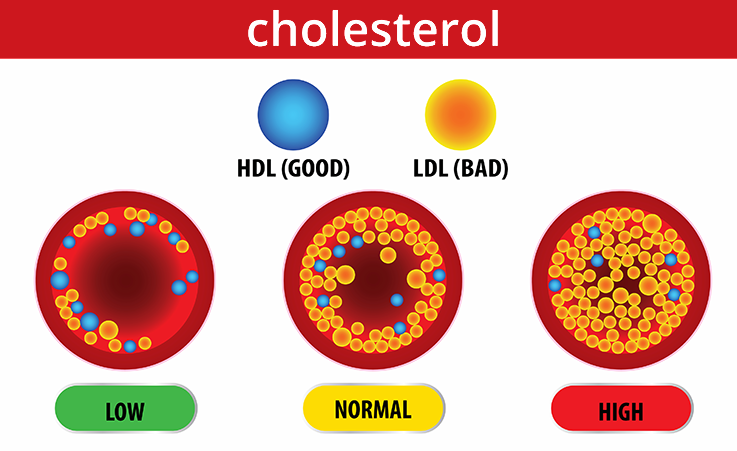
3. All cholesterol is bad for your heart and blood vessels. T F
The Centers for Disease Control and Prevention point to high - density lipoproteins (HDL), or "good" cholesterol, as a source for production of hormones and cell construction. Keep your HDL to LDL (low density, or "bad cholesterol") high, and manage your LDL through lifestyle changes and your healthcare provider's assistance.
4. Describe common behavioral methods for managing your triglyceride levels.
According to the Cleveland Clinic, you may have a significant chance to lower your triglyceride levels in your blood when you get regular aerobic exercise, eat healthy and maintain a weight that is good for you. For example, a diet that may be helpful in lowering triglycerides would include: low amounts of fats, of sugars, and of simple carbohydrates and alcohol. Your healthcare provider might direct you to consider medication (e.g. statins) to manage very high triglyceride levels.
5. Areas on your body that do not allow for reliable blood pressure readings include:
A. Earlobe
B. Finger
C. Toe
D. Upper arm
E. Wrist
The American Heart Association says that blood pressure cuffs, fitted around the upper arm, provide the most reliable blood pressure readings. Even though wrist cuffs are available in many 'big box' stores, their reliability is suspect. Earlobe and finger readings are not widely accessible outside research or clinical settings.
6. Supplements like ___B vitamins____ and __magnesium_____ help stabilize your blood sugar levels.
A 2015 paper in the journal Endocrine, Metabolic and Immune Disorders Drug Targets by Valdes'-Ramos et al., included the conclusions that eating foods containing ample amounts of the nutrients above, among others, is the best approach to increase control of type 2 diabetes. Use of dietary supplements to augment other medical treatments for diabetes, remains an individual decision until further research fills in the blanks about supplements' roles.
7. Reluctance to eat protein could be a sign of kidney disease. T F
A 2018 meta - analysis in PLoS One of 19 randomized controlled trials, on the relationship between protein consumption and chronic kidney disease (CKD), revealed that the rate of decline in kidney function, as well as the risk of kidney failure for persons with CKD, may be slowed by a low - protein diet. Not wanting to eat protein, by itself, indicates you may have kidney disease. There is still limited understanding of how much protein consumption among cohorts is best.
8. Explain how rheumatoid arthritis can lead to cardiovascular disease.
Inflammatory processes engaged in the body by rheumatoid arthritis (RA), can lead to buildup of lipoproteins that may bring about cardiovascular disease. Be proactive! Reduce your levels of inflammation. Treat signs of cardiovascular disease. Fight the risk factors hard!
9. Women's health risks that do not trend with cardiovascular disease include:
A. Hormone replacement therapy
B. Mommy's locked in the bathroom
C. Oral contraceptive use
D. Pre - eclampsia
E. Preterm delivery
Option "B" is a temporary respite from shocks to the heart.
10. South Asians will benefit from lower cardiovascular risk, by focusing on their best levels of _HbA1C_, _physical activity_ and _carbohydrates in the diet_ (Cardiology magazine, 5/17/2019).
11. E - cigarette use is safer for adults than smoking or otherwise using tobacco. T F
The U.S. Surgeon General, the Department of Health and Human Services, and Northwestern University Medicine each document on their websites, factors including the ingestion of toxic minerals (e.g. aluminum, tin, nickel), the consumption of high levels of nicotine relative to that in tobacco, and the potential for both injury to the developing brain, and the lungs, which point to e-cigarette use as extremely risky to health.
12. Talk about what habits of yours have most helped you maintain a healthy weight.
I keep a balance in my life, that helps me keep my weight where I need it to be. I watch the portion sizes of my meals, so I get the nutrition I need. My daily diet allows me opportunities for sufficient protein, fiber, essential nutrients and water. I exercise at the level that affords me at least moderate cardiovascular benefit. Stress I manage through my fitness work, cognitive - behavioral work, and leisure pursuits. I sleep to refresh the brain and body. It's a constant discipline, with pauses inserted to relax and 'cheat'.
13. Takeaways from any discussion of a genetic predisposition for CVD should mention:
A. If you have CVD, your siblings have a 40% greater risk of developing CVD.
B. You face a 60 - 75% higher risk of CVD, if your parents presented with CVD.
C. Nothing you might achieve from lifestyle management can lower your CVD risk.
D. Your risk for having a heart attack (myocardial infarction) is increased, if one parent had an MI.
E. The Developmental Origins of Health and Disease
framework gives researchers and clinicians, tools for better
understanding the transmission of CVD between branches of a family tree.
Two 2014 studies published in the journal Canadian Family Physician cite statistics for options "A", "B", and "D". A 2018 paper in the Journal of Physiology takes the study of pre- and perinatal effects upon the health of individuals to a mechanistic level,by comparing the fetal developments of humans with those of guinea pigs.
THERE. I hope you've enjoyed the brief experience in the wide world of cardiovascular disease. It's also my wish that you see there is a place for the SLP clinician, helping her consumers learn to manage risk factors for CVD.